
From Delhi to Agra: Elephants, Love Stories, and Two Highway Pit Stops

The Yamuna Expressway is less a highway and more an unscripted Bollywood drama—tractors, cows, and helmet-free bikers vying for space while sacred cows judge the chaos from the sidelines. Our journey to Agra included not one, but two memorable pit stops: a pricey latte at Highway Masala (worth it for the clean restroom alone) and a Butter Paneer Burger at McDonald’s that redefined fast food. But the real highlight was the Elephant Conservation and Care Centre, where majestic giants, once abused, now thrive in peace. Add a glittering Taj Mahal love story performance to the mix, and you’ve got a day as unforgettable as it was chaotic.

Our day began in Delhi with a warm and hearty breakfast at Prakash Kutir, where Ajay and Savita’s hospitality could convince anyone to stay forever. But the road to Agra beckoned, promising elephants, a taste of history, and adventures along the way.

The Yamuna Expressway: A Highway of Contrasts
Part of the Yamuna Expressway

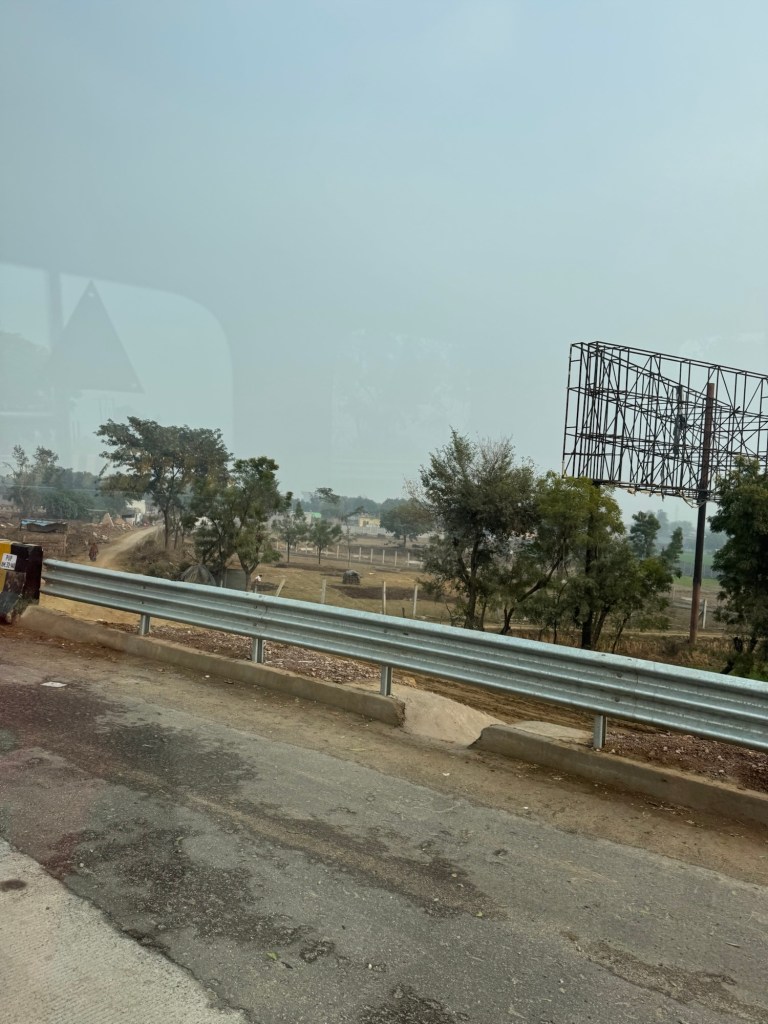
The Yamuna Expressway is less a highway and more an unscripted drama. Tractors share lanes with speeding cars, helmets and seatbelts are treated as optional, and sacred cows amble about as if they own the place (they probably do). The roadside scenery is an ever-changing slideshow of paddock cricket matches, brick kilns, and rubbish that stretches endlessly. There was even a dead dog and more than one abandoned bicycle—because why not add a little mystery to the mix?How did that dog die? I find myself wondering. It did not look like he’d been run over, possibly malnourishment or exhaustion I suspect.

Our first stop was Highway Masala, a roadside haven where I indulged in a latte that cost 335 rupees ($6.33 after tax and tip). Pricey, yes, but after a morning of visual chaos, it was worth every penny. Karen, our ever-resourceful guide, tipped the restroom attendant generously, ensuring we all got to freshen up in clean, civilized conditions—a rare and much-appreciated treat on this journey.

Back on the road, the conversations in the bus merged into a pleasant hum as we passed Mathura’s signature brick-making kilns and teenagers playing cricket on any patch of dirt they could find. My travel thoughts turned contemplative, but hunger soon pulled me back into the moment.

Lunch at McDonald’s: A Quick Bite Before the Elephants

With the Elephant Conservation and Care Centre (ECCC) as the day’s highlight, Karen, ever mindful of the clock, opted for a no-nonsense lunch at McDonald’s. This was not McDonalds as we knew it in Australia; this was India, and I embraced it wholeheartedly by ordering a Butter Paneer Burger (despite the fact I avoid McDonald’s and any fast food ordinarily). Equal parts spicy, buttery, and satisfying, it felt like a tiny triumph of Indian flavor over fast food uniformity.

The quick meal allowed us to stay on schedule while fueling up for what we all knew would be the most impactful part of the day—the visit to the elephants.

Elephant Conservation and Care Centre (ECCC): A Sanctuary of Second Chances

An impactful presentation…why this work is so important.

Mathura brought us to the ECCC, a sanctuary dedicated to rescuing and rehabilitating abused and exploited elephants. Here, these majestic animals are given a second chance at life, free from the chains—both literal and figurative—that once bound them. Each elephant has a story, and hearing them is equal parts heartbreaking and hopeful. The presenter was exceptional. What is most impressive is the centre’s focus on rehabilitating the elephants owners and family as well in order to break the cycle altogether.

The chains that once bound…

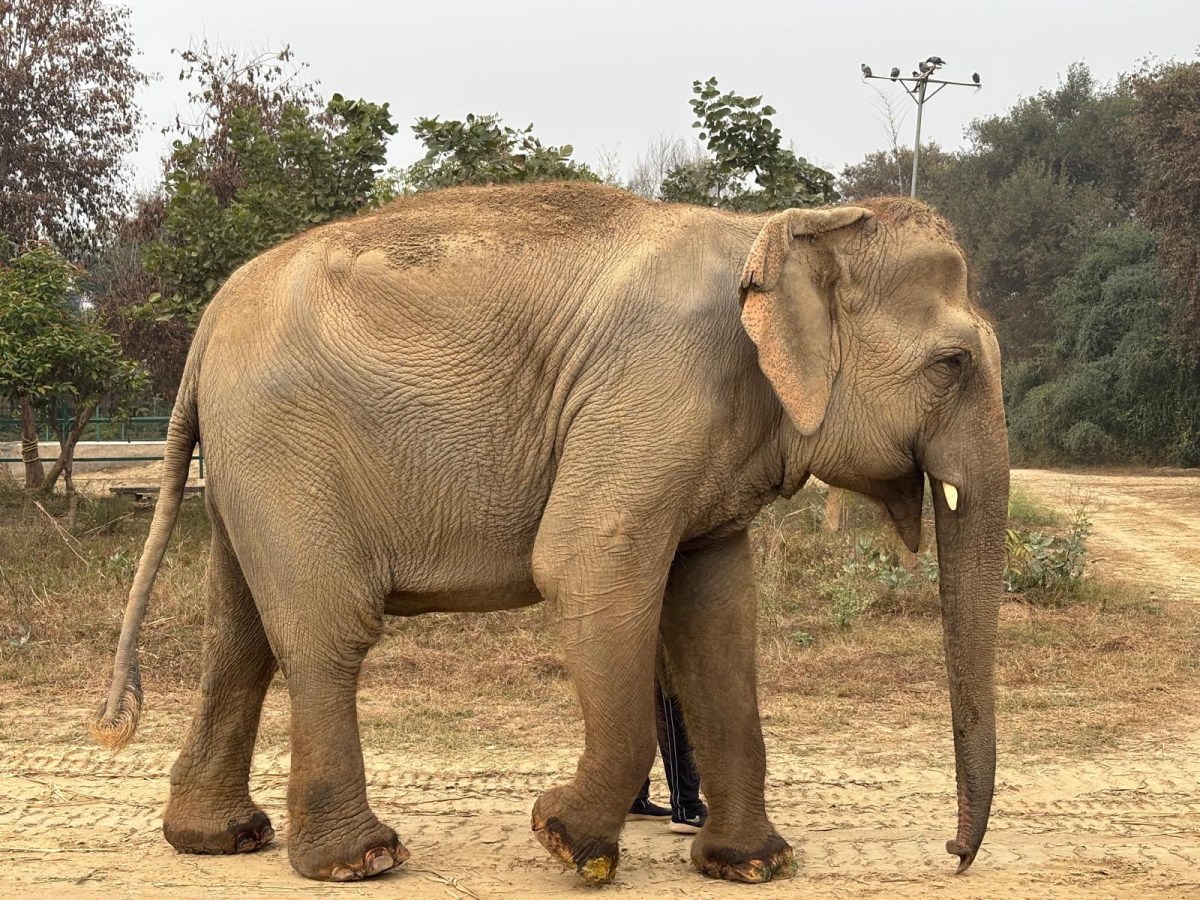
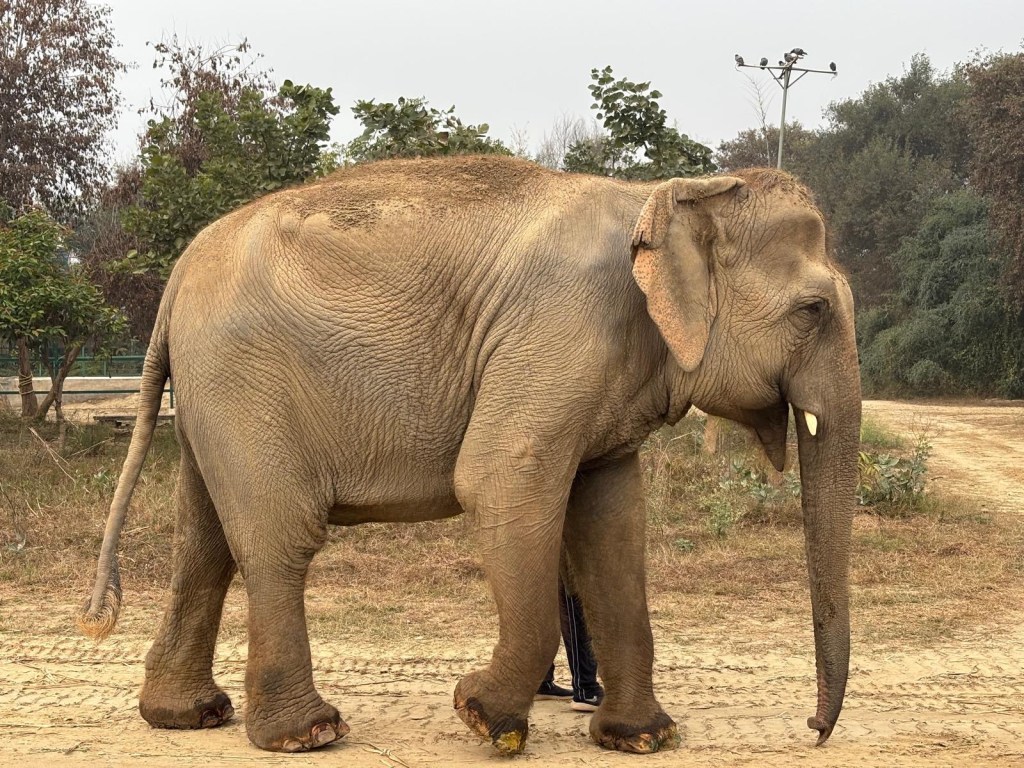
Mia, who spent decades performing in circuses and was often starved and beaten had arrived at the centre in a state of abject physical and mental distress. Now she spends her days basking in the sun, playing in the mud, and eating nourishing food alongside her BFF Rhea. Learning about the abuse these elephants endured and seeing their transformation into happier, healthier creatures was a humbling experience that left us all a little more compassionate—and a lot more aware.
https://wildlifesos.org/

Mia aged 52 – note her poor feet needing continued treatment as a result of abuse suffered before being rescued.

Agra: Love, Lights, and a Bit of Contemplation

As we arrived in Agra, the chaotic energy of the day gave way to the serene charm of Da Bungalow, a retreat that combines modern comfort with traditional Indian aesthetics.

The evening took us to the Agra Mohabbat The Taj Show, a glittering spectacle that brought the love story of Emperor Shah Jahan and Mumtaz Mahal to life. With its vibrant costumes, entrancing music, and heartfelt performances, it was the perfect way to end a day that had already felt larger than life.

Reflections on the Journey

As we made our way back to Da Bungalow, the chatter of the group softened, and my thoughts drifted to the changes awaiting me back home. My house is on the market, with a buyer viewing it tomorrow morning. Will my next chapter take me to another town? Or, will I stay in the town I’ve come to love. These questions hung in the air, unanswered but oddly comforting in their ambiguity.

For now, I am content to let the answers come in their own time. Tomorrow, the Taj Mahal awaits. If it’s even half as spectacular as the Butter Paneer Burger, I’ll call it a win. For today, I’m just grateful for elephants, clean restrooms, and the magic of being present on this wild, wonderful journey.

Data for Self-Awareness—Tracking the Unseen

After I was clearly on the road to recovery post-cancer, I decided to visit a nutritionist. She wasn’t just any nutritionist; I chose her because she could run tests and set a benchmark for my health—something concrete I could improve upon. During our session, I shared my story about being diagnosed with breast cancer after I’d ignored a lump the size of a child’s fist for who knows how long. I’ll never forget her reaction. She paused, looked at me, and said, “Wow! How disconnected from your body must you have been to forget about a lump that size?”

That comment struck me like a slap in the face. She was right. I had been completely disconnected from my body. I lived in my head—everything was logic, work, and routines. Get up, get dressed, feed the kids, look after my husband, go to work, pay the bills… rinse and repeat. I was on autopilot, and it was clear I had been ignoring my body’s signals for a long time. Looking back, the signs had been there, flashing like neon lights, but I didn’t see them—or rather, I chose not to.

Now, post-cancer, I had the chance to do better, and I was not going to waste it. Tracking became a crucial tool for me, not just as data for the sake of data, but as a visual reminder to tune in to my body—really listen this time. It wasn’t about obsessively measuring everything; it was about using that information to rebuild a connection I had lost. This body is our vehicle through life; if we learn to listen, the signals are there. The power of tracking is in the lessons it teaches us about those signals, guiding us to take better care of ourselves and live more consciously.

Why Track Your Well-Being?

Sadhguru’s Inner Engineering emphasizes the importance of awareness—being present and conscious of your body, mind, and energy. But here’s the thing: when you’re stuck in the daily grind, it’s easy to miss your body’s subtle signals. I ignored mine, and it nearly cost me everything. Tracking is a way to reawaken that awareness. It helps you pay attention to what’s happening under the surface—your mood, habits, sleep—and gives you the tools to see the patterns you might otherwise miss.

Tracking gives you a moment to pause, reflect, and say, “What’s going on here?” It’s not about micromanaging your life but about using data to reconnect with yourself—so you don’t end up on autopilot like I did. Once you understand the rhythms of your body and mind, tracking becomes less necessary, but initially, it can be a game-changer.

Practical Ideas for Data-Driven Self-Awareness

1. Mood Tracking: Listening to Your Inner State

When I was disconnected from my body, I barely noticed my emotions unless they hit me like a brick. Mood tracking is a way to get in touch with the fluctuations in your emotional state and start noticing the subtle shifts before they escalate. By logging your mood each day, you’ll start to see what’s impacting your well-being, whether it’s a bad night’s sleep, a stressful workday, or skipping your yoga practice.

As you track, patterns will start to emerge. You’ll notice that when you meditate, your mood improves. Or when you skip breakfast, you get irritable by lunchtime. Mood tracking helps you become aware of these patterns, so over time, you can simply feel what’s going on without needing the logbook. It’s a tool to help you learn how to listen.

How to Start:

  • Track your mood at different times of the day. It can be as simple as giving your mood a score from 1 to 10 and jotting down a few notes.
  • After a few weeks, look at the data and see if any trends stand out. What activities improve your mood? What drains you?
  • Eventually, you’ll no longer need to log the data because you’ll know what’s helping and hindering your emotional well-being based on how you feel.

2. Habit Tracking: Becoming Aware of Your Daily Actions

One thing Sadhguru teaches is the importance of bringing consciousness into everything we do. When we live unconsciously, we end up in patterns that may not serve us well—just like I ended up ignoring the signs from my body. Habit tracking brings those unconscious actions into the light. By tracking habits like daily yoga, mindful eating, or time spent outdoors, you become aware of what you’re doing and how it’s affecting you.

At first, it’s about accountability. You’re tracking to ensure you’re keeping up with habits supporting your health. But over time, as you learn to feel the impact of those habits, the tracking fades into the background. You’ll know if you’ve skipped your evening meditation because you’ll feel it—not because your app tells you.

How to Start:

  • Choose 2-3 habits that align with your well-being goals (meditation, drinking more water, going for a walk).
  • Track them daily. Did you do them? How did they make you feel?
  • After a few weeks, you’ll notice which habits have the most impact. The tracking will become less necessary once you’re in tune with your body.

3. Sleep Analysis: Learning to Honor Your Body’s Need for Rest

Sleep was one of the first areas I realized I had to take seriously after my cancer diagnosis. Sleep is when our body heals, but many don’t respect it—burning the candle at both ends and then wondering why we’re exhausted. Tracking your sleep can help you see how much rest you’re getting and what’s affecting your sleep quality.

If you’re consistently waking up tired, it could be that your late-night Netflix habit or caffeine intake is throwing off your natural rhythm. Over time, tracking your sleep helps you understand what your body needs to function well. And eventually, you’ll start to feel those cues without requiring a device to tell you.

How to Start:

  • Use a sleep tracker or journal to log how many hours you sleep, your quality of rest, and how you feel the next day.
  • Notice the patterns—do you feel more refreshed after an early bedtime? Does your energy dip if you stay up late?
  • Once you’re aware of how your body responds, you’ll naturally start to honour your need for rest without the need for constant tracking.

Bridging Data and Inner Awareness

The power of tracking isn’t in the data itself; it’s in the awareness that comes from it. I noticed how they all connected once I began tracking my mood, habits, and sleep. I learned to listen to my body in ways I hadn’t before. The more you practice, the more intuitive it becomes. Eventually, you won’t need to track every detail because you’ll feel when something’s off, just like I now know when I’m veering off course. Tracking is a tool to reconnect with yourself—but it’s not a crutch.

Sadhguru’s teachings remind us that true well-being comes from within. Once we develop the inner awareness to listen to our bodies, tracking is no longer required. But when life gets chaotic or when we feel out of sync, tracking is a tool we can return to for a recalibration—a way to check in and realign.

When to Track and When to Let Go

Tracking is like training wheels. It helps us recognise our actions, moods, and energy levels. But the goal is to eventually ride the bike without them. Once you identify the correlations between what you track and how you feel, you’ll know when your body needs rest, movement, or nourishment without requiring the data to confirm it.

But that doesn’t mean you never come back to it. If life gets out of balance, tracking can be a helpful way to realign and get back on track.

Final Thoughts

For me, tracking was a way to rebuild my connection with my body after cancer woke me up to how disconnected I had been. It was a tool for self-awareness, not just numbers on a screen. Whether you’re tracking mood, habits, or sleep, the purpose is to learn how to listen to your body and mind. Once you’ve deepened that awareness, you won’t need the data anymore—because you’ll already know what your body is telling you.

But here’s where I’d love to hear from you. I used to feel that if I stopped tracking, I’d failed at it—another task I hadn’t kept up with. How do you feel about letting go of tracking once you’ve learned the signals from your body? Does the idea of letting go feel liberating, or does it feel like losing control? Have you experienced that shift where you no longer need a tracker but can intuitively feel what your body needs?

I’d love to hear your thoughts and experiences! Let’s start a conversation about finding the balance between tracking and trust and becoming more deeply connected with ourselves.