
Namaskar from India: Navigating Chaos, Culture, and Curiosity

India is a place that defies neat descriptions. It’s vibrant, chaotic, soulful, and layered with more stories than one blog post could ever capture. From the cacophony of horns to the historical grandeur of the Mughal dynasty, every moment here is alive with contrasts.

Take the roads, for example. Driving in India is its own kind of performance art. And here’s a fun fact: it’s considered rude not to honk your horn before passing a vehicle. Honking is less about aggression and more about communication—a polite “Namaskar” to let others know you’re coming through. Trucks often display signs like “Blow Horn” or “Use Dipper at Night,” making it clear that honking isn’t just tolerated—it’s expected. It’s noisy, yes, but it’s also strangely efficient in its own chaotic way.

Reading the Roads: A Crash Course in Indian License Plates

One of the first things I noticed during my time here was the kaleidoscope of vehicle registration plates. Each tells a little story about where the vehicle comes from and its purpose:

• Yellow Plates: Commercial vehicles—taxis, trucks, and buses hustling to their next destination.

• White Plates: Private vehicles, carrying families, professionals, and everyday life.

• Green Plates: Electric vehicles—a hopeful sign of sustainability amidst the bustling chaos.

• DL: Vehicles registered in Delhi.

• RJ: Rajasthan, for those that call the majestic desert state home.

Every plate is like a postcard from a different corner of India, a reminder of how vast and diverse this country is.

The Streets Are Alive

India’s streets are more than just thoroughfares—they’re stages where life unfolds in all its raw beauty. Children play in the middle of the road, darting between cars and laughing with uncontainable joy. Others wash windows at traffic lights or paint gutters with a focus that’s both industrious and surreal. It’s a scene that tugs at your heartstrings, reminding you of the resilience and creativity that thrive even in the midst of challenges.

Tastes of Tradition: Semolina and Chickpea Flour

The food here is an adventure in itself, and my taste buds are having the time of their lives. Indian cuisine has a way of turning the simplest ingredients into something extraordinary. Take semolina and chickpea flour, for example. These humble staples are transformed into delicacies like soft, spongy dhokla or crispy, golden pakoras. It’s a reminder that in India, food isn’t just nourishment—it’s art, tradition, and a celebration of flavor.

A Glimpse into History: The Qutb Monuments and the Mughal Dynasty

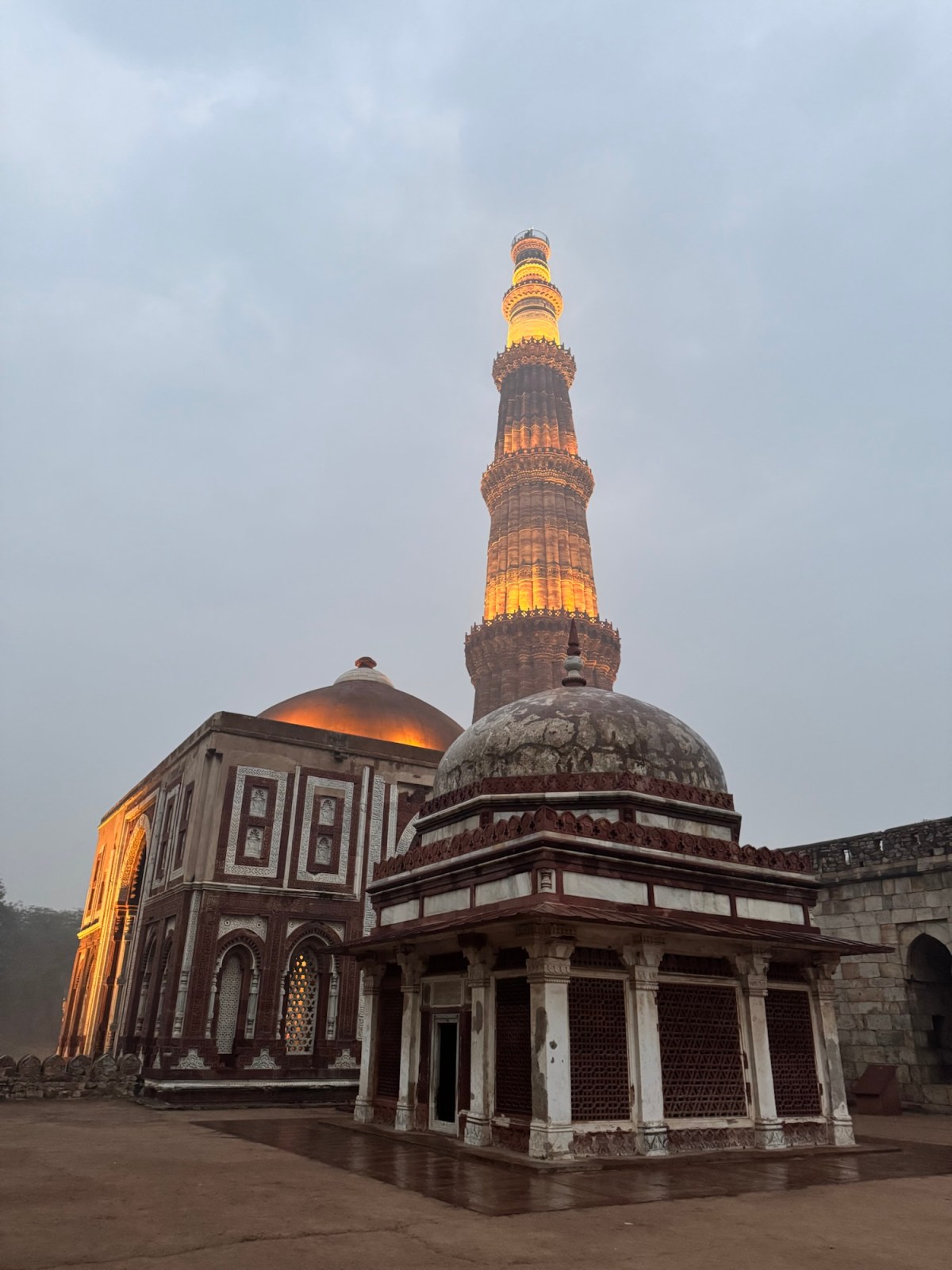
India’s history is as rich and layered as its food. Exploring the Qutb Minar Complex in Delhi, I found myself awestruck by the scale and intricacy of these ancient structures. The Qutb Minar, a towering sandstone minaret built in 1193, rises like a sentinel over centuries of history. The surrounding ruins, including the Quwwat-ul-Islam Mosque, tell stories of conquest, faith, and architectural brilliance.

This is the legacy of the Mughal dynasty, whose influence can still be felt in everything from India’s cuisine to its art and architecture. Walking through these monuments, it’s impossible not to feel a sense of reverence for the grandeur and ingenuity of those who came before us.

Finding Balance in the Chaos

India has a way of throwing you off balance—and then teaching you how to find your footing again. It’s in the blaring horns that somehow create order from chaos, the children who turn busy streets into playgrounds, the food that speaks of centuries-old traditions, and the monuments that whisper stories of a time long gone.

Travel here isn’t always comfortable, but it’s always meaningful. It demands that you stay present, that you open yourself to the unfamiliar, and that you find beauty in the mess. India doesn’t just show you the world—it shows you yourself, reflected in its vibrant, unfiltered mirror.

So, if you find yourself here one day, listen for the horns, taste the pakoras, marvel at the history, and let the chaos guide you to something extraordinary. Namaskar, my friends—welcome to the journey.


Finding Joy in Packing Up Memories

In the chaos of post-Christmas packing, the narrator grapples with a monumental task that evokes nostalgia and emotion. Each item unearths memories, blending laughter and tears. Emphasizing small victories, the process becomes a journey of letting go and making space for future growth, ultimately finding humor and humility in the mess.

It’s just a few days after Christmas, and here I am, staring at my house like it’s a life-sized game of Tetris, with pieces I have absolutely no idea where to put. The task before me is monumental: pack up my home, get it ready for inspection, and somehow, miraculously, make it all happen before I fly to India. Simple, right? Except it’s not. Not even close.

I start the day ambitiously, tackling three spaces at once—the garage, the upstairs landing that needs painting, and my walk-in wardrobe. Rookie mistake. Within an hour, my head is pounding, my patience is gone, and my house looks more chaotic than when I started. It’s like I’ve unleashed a tornado, but instead of Dorothy and Toto, it’s me in leggings, clutching a paintbrush in one hand and an old sweater I can’t part with in the other. Honestly, even Marie Kondo would throw her hands up and walk away at this point.

I pause and do the only thing that seems remotely sane: I clear the dining room table. Just the table. One surface, one tiny victory. And it feels glorious. I can see the wood again, and for a moment, I convince myself I’ve got this. Of course, the rest of the house is still a disaster, but I decide to reward myself with something that always helps me find my footing: writing.


When Memories Hide in Clutter

As I wade through my stuff, I quickly realise this is about more than just packing. Every box I open, every drawer I rifle through, feels like opening a time capsule. There’s the top I wore on that disastrous first date. There’s my boys’ old Lego set, the one I swore I’d never step on again, and here it is, mocking me. Each item carries a memory, and with each memory comes a wave of emotion that crashes over me like an unexpected tsunami.

I try to ride the waves, but let’s be honest—it’s messy. Sometimes I laugh; sometimes I cry. Occasionally, I find myself doing both simultaneously, which must look absolutely ridiculous. But this is where I am: mid-fifties, physically fit (thankfully), and knee-deep in a task that is equal parts cleansing and chaotic. I’m grateful to have the energy to do this on my own, but let’s not romanticize it—this is hard, humbling work.


Finding Humility (and Humor) in the Mess

Something about packing up your life makes you realise how absurdly attached you are to random objects. Why am I holding onto the hideous vase a distant relative gave me in 1992? Why do I own three fondue sets when I’ve never made fondue? And why, oh why, did I think it was a good idea to start painting and packing and decluttering all at once? I have to laugh because if I don’t, I might cry again, and I’m trying to pace myself on the tears.

But I do know why I’m doing this. Letting go here, in this nurturing space that has been my home for over a decade, feels important. This house has held so much of my story, and clearing it feels like honoring the past while making room for the wonderful things I know are coming my way in 2025.

Writing gives me a chance to breathe, to step back from the chaos and make sense of it. It helps me process the emotions that rise like a tide—sometimes gentle, sometimes relentless. I remind myself that these e(motions)—energy in motion—are a natural part of clearing space. As much as I’d like to think I’m in control, the truth is, I’m just here for the ride, trying to keep my sense of humour intact.


Small Wins, Big Lessons

Clearing that dining room table taught me something important: start small. One surface, one drawer, one box at a time. It’s not about doing it all perfectly or all at once. It’s about finding those little wins that keep you moving forward. Each cleared space is a reminder that I’m making progress, even if it doesn’t feel like it in the moment.

This process isn’t just about letting go of clutter. It’s about creating space—for growth, for joy, for whatever comes next. As I pack up my house, I’m not just saying goodbye to things; I’m saying goodbye to old stories, old identities, and old expectations. And that, my friends, is no small feat.


Embracing the Waves

When the tsunami of emotion hits, I grab my pen and write it out. Writing helps me remember that these waves, as overwhelming as they feel, will pass. It reminds me to breathe, to laugh at the absurdity of it all, and to trust that I’m exactly where I’m meant to be—surrounded by chaos, covered in paint, and slowly, steadily clearing space for what’s next.

And you know what? That’s enough. One box, one memory, one laugh-cry at a time, I’m moving forward. Here’s to finding humour, humility, and maybe even a little joy in the mess.

Finding Peace This Christmas: A Journey of Growth

Christmas Eve Morning: A Sacred Stillness

It’s Christmas Eve morning. Like most mornings, I wake to the soft dawn light. It streams through the open shutters of my bedroom overlooking the Blue Mountains. Today’s light feels particularly radiant, bathing the room in a golden glow and promising the start of a beautiful day. The sun rises with its unhurried elegance, and I find myself drawn to my yoga mat, grounding myself in meditation. I savor the stillness of this sacred moment, letting the peace wash over me.

Unusually, my peace is interrupted by a phone call. It’s my partner, 60 kilometers away, gently reminding me that he’s patiently waiting for my arrival later today. Christmas treats are packed, and together we’ll prepare our lunch for tomorrow. His kind voice carries a reassurance that surprises me. I feel truly at peace. This happens even in this quieter, more solitary lead-up to Christmas.

Christmas has always been a complex time since my divorce. With my boys no longer at home, it has often felt tinged with loneliness. In past years, I buried those feelings in busyness. I cooked meals for my parents and took them to their home. I visited my sister, brother, and aunt, all in separate places. The constant flurry of activity left little time to sit with my emotions.

This year has been different. I’ve intentionally allowed myself to feel the emotions for the first time. I’ve processed the emotions that surfaced in the weeks leading up to today. Instead of pushing them aside, I’ve worked through them, piece by piece. And now, as Christmas approaches, I’ve reached a quiet acceptance: everything is exactly as it is meant to be. There’s peace in letting go of the past and embracing the moment, just as it is.


2024: A Year of Challenge and Growth

2024 was a challenging year—there’s no doubt about that. But as the months rolled on, I discovered something remarkable: I’ve gotten better at navigating life’s inevitable ups and downs. Yes, some moments tested me. There were tears, big emotions, and times when life threw its curveballs. But I’ve learned not to let those moments keep me down for long.

I’ve started embracing emotion for what it truly is—e(motion)—energy in motion. It’s meant to move through us, not get stuck. Brene Brown’s analogy that emotions are like trains traveling through a tunnel resonates deeply with me. Solitude is the gift that lets me sit with my emotions. I can feel them fully. Then, I let them pass through that tunnel. And here’s the beautiful part: as I practice this, I notice the process gets quicker. How powerful is that? I realise I can shift my emotional state. I do this not by suppressing it but by feeling it. I release it and embrace the growth it brings. Honestly, it feels like I’m developing a superpower.

So, what’s changed? A big part is the sacred, joyful collection of rituals and practices I’ve created for myself. They’re small things—simple and ordinary—but they bring me immense joy. It is a morning meditation. It’s a walk in the mountains. It is lighting a candle at the end of the day, or at the beginning of a yoga practice. These practices honour my own needs. They keep me grounded. They’re the foundation. They allow me to show up for others in a true way. I do this without losing myself in the process. Most of the time, anyway. Let’s call it progress, not perfection. 😉


Closing One Chapter to Open Another

Five years after my divorce, I finally feel ready to let go of something I’ve held onto tightly: my home. Yesterday, I signed the contract with the agent. I spent so much time toying with the idea of selling. I often wondered what life might look like beyond these walls. Suddenly, it felt right. The decision didn’t come overnight—it’s been a slow, deliberate process. I’ve entertained the idea. I have contemplated it in my mind and heart. I tried it on for size in countless ways. But now, I feel ready to close this chapter and start anew.

As Rumi so beautifully says:

“This is love: to fly toward a secret sky, to cause a hundred veils to fall each moment. First to let go of life. Finally, to take a step without feet.”

That’s exactly where I find myself. I have no clear picture of what 2025 will bring. I know that I’ll no longer be tied to the identity this home has attached to me. It defined me as mother, wife, suburbanite, and host. It’s time to redefine myself without the labels this space has so lovingly carried for me. It’s a leap into the unknown, but for the first time, it feels exhilarating rather than daunting.


Looking Ahead to 2025

Anticipation and Gratitude: Embracing What’s Next

I am flying to India in January, and with each passing day, the anticipation builds. People tell me such a journey can be life-changing. But here’s the thing: when you live fully in the moment, every moment is life-changing. There are no expectations, no regrets—just the now. How freeing is that?

Perhaps when I return, a new home will have found its way to me. Perhaps it will take longer. Who knows? All I know is this: I’m embracing the unknown for what feels like the first time in my 55 years. As I write this, if I’m honest, I remember this feeling from childhood. I’m embracing it with a sense of wonder. It’s that same exhilaration I felt as a little girl when I discovered the tree outside my bedroom window and begged my mum for a spoonful of Vegemite to fuel my climb. That pure, unfiltered anticipation is what I’m feeling now as I look ahead to 2025.

The thought excites me. It’s a blank canvas. It’s an opportunity to create a space that reflects who I am now. It does not reflect who I’ve been. The Blue Mountains will stay my sanctuary. My future identity will be lighter and freer. It will be untethered from the stories of the past.


Gratitude for the Chapter That’s Closing

This Christmas, I am preparing to leave the home that has held so much of my story. I’m overwhelmed with gratitude. I’m grateful for the years I’ve spent here. I appreciate the growth it has nurtured. I admire, in myself, the courage it has taken to finally step into what’s next. This home has been a place of love, resilience, and transformation, and now it’s time to carry those lessons forward.

If there’s one thing I’ve learned, it’s this: the joy we cultivate within ourselves radiates outward. It helps us show up, serve, and live fully—without losing sight of who we truly are. That joy is my anchor as I move into this next chapter.


Carrying Peace Into the Holidays

As the day unfolds, I’ll pack up the Christmas goodies and head to my partner’s place. But I won’t just be carrying treats—I’ll be bringing the joy and peace that have taken root in my heart. This Christmas feels different, lighter. It’s a season of transition, a celebration of what’s been and what’s to come. Wherever this journey takes me, I’m ready to greet it with open arms and a heart full of gratitude. Wherever you are today, I hope you’re finding your own moments of stillness. I wish that you experience joy and maybe even a little courage to take a step without feet. Wishing you a Christmas filled with light and love. 🎄✨

The Four Dharma Principles for Peace and Clarity

In 2016, I found myself lying on my bathroom floor, utterly spent from yet another round of chemo. I was somewhere between exhaustion and sheer determination. I started listening to Yoga and the Dark Night of the Soul by Simon Haas on Audible. As I have already mentioned, I was searching for anxiety antidotes. That book opened the door to new possibilities. A new way of thinking and over time, a new way of being. Soon enough, I had The Book of Dharma lined up. It was set to be my next dose of inspiration.

As the YogiCFO, I aim to balance Dharma and Data. I thought now is a good time to introduce Dharma.

I was drawn to yoga when I heard it described as the “Science of the Mind.” This wasn’t about blind faith or dogma. It was about trying things out and seeing what worked. I kept only what resonated with me. That same spirit of experimentation drew me to dharma. In ancient Indian texts, dharma was the set of principles used to guide sovereigns in ruling wisely. And, after facing cancer, I came to realize I was my own “sovereign” in the truest sense. Cancer made one thing clear: every choice I made came with consequences, and only I could walk that journey. I wanted my decisions to be rooted in wisdom, not fear. I realised life was short, and prior to this, I was not really fulfilling my potential.

For me, dharma has been less of a rulebook and more of a compass, as Simon Haas describes it. It’s a way to navigate life with purpose by holding close four principles: Truth, Purity, Non-Violence, and Discipline. I’m not here to tell anyone else how to live. I can say that these principles have offered me a lifeline when I needed one. Through the storms of cancer treatment and chronic pain, facing the haunting fears of recurrence, and learning to find peace in solitude, dharma has been a gentle guide back to myself. Here’s how each principle has shown up for me.


Truth: The Art of Being Honest with Myself

Truth sounds straightforward, right? Just be honest. But after a cancer diagnosis, honesty takes on a new level. I convinced myself for a while that I was okay, that I was moving forward without fear. But if I was honest, I was living with a constant, nagging worry about recurrence. Truth, I learned, isn’t about pretending to be fearless or always having it together—it’s about admitting when I don’t.

These days, Truth means being real about my fears and not burying them under a mask of “I’m fine.” Sometimes, that’s admitting I’m scared or that I’m not okay. By acknowledging what’s really going on, I can acknowledge it, notice how it makes me feel and let it go. Truth, as it turns out, has been a source of freedom for me. It allows space for the parts of myself that need compassion. This is much better than denial.


Purity: Clearing Out the Clutter to Find Peace

Purity isn’t about some impossible level of perfection; it’s about clarity. For me, this principle became vital as I learned to manage chronic pain. Pain is exhausting—mentally, emotionally, physically. If I let my mind fill up with resentment, it only worsens the situation. Adding frustration is like fueling an already intense fire.

So, Purity for me is about letting go of that mental clutter and simplifying. I make time each day to clear my thoughts through meditation or writing. I let go of the “extras” that don’t serve me. Even physically, I’ve pared down my space to include only things that bring some peace or joy. Creating this clarity doesn’t make the pain go away. However, it allows me to be present with it. Instead of getting lost in the fog of frustration, I can face it directly. When I keep things clear, I feel a bit more in control. I feel this way even when the pain is out of my hands.


Non-Violence: Treating Myself with Kindness (and Forgiving the Not-So-Great Days)

Non-Violence, or Ahimsa, has been a real journey. It’s about compassion, both toward others and myself. This hasn’t come easily for me, especially when it comes to loneliness. Loneliness can make even the most grounded person feel off-kilter. But I’ve found that when I practice Non-Violence toward myself, I can transform loneliness into solitude. Solitude becomes a place where I can grow and find meaning instead of just feeling isolated.

Some days, that means I let myself rest rather than pushing through. Other days, it’s letting myself feel what I’m feeling without layering on guilt or criticism. And yes, some days it’s as simple as reaching out to a friend. I don’t have to sit with the feeling that I need to do it all alone. Non-Violence reminds me that I deserve kindness, even on the hardest days. This is one of the most powerful lessons I’ve found in dharma.


Discipline: Showing Up for Myself, No Matter What

Discipline used to feel rigid, all about self-control and willpower. But these days, discipline feels softer, like a commitment to myself. After cancer, I needed to rebuild my routines, to show up in ways that nurtured rather than depleted me. Discipline became my way of finding stability in the chaos.

Keeping a bedtime routine, doing my yoga, or sticking to my morning tea ritual are acts of discipline. They remind me I’m worth the effort. The small choices matter. Each one builds on the other. They create a foundation I can rely on even when life throws a curveball. Discipline isn’t about being harsh with myself. It’s about staying consistent with the things that help me feel grounded and whole. Over time, discipline enables freedom.


Living by Dharma as a Gentle Guide

As Haas explains, Dharma isn’t about rules. It’s more of a framework, a gentle guide that brings clarity and helps me focus on what really matters. I’m not here to preach. I won’t tell anyone else what to do. These four principles have offered me something I desperately needed: a way to live with intention. They help me stay present, choose peace over chaos, and show myself some compassion in the process.

The real beauty of dharma is that it doesn’t demand perfection. Some days I’ll nail it, and other days? Well, we all have those days. I realign with Truth, Purity, Non-Violence, and Discipline. Then I feel like I’m steering my life more purposefully. Life won’t ever be perfectly smooth. However, it feels a little lighter. It feels a little clearer. Life becomes much more manageable when I have these principles as my compass.


Finding Your Own Path

As Simon Haas explains, the power of dharma truly shines when all four principles—Truth, Purity, Non-Violence, and Discipline—work together, supporting each other to create a balanced and purposeful life. Each principle reinforces the others, guiding us to make choices with integrity, clarity, compassion, and commitment. If you’re curious about dharma, try engaging with each principle in small, manageable ways, observing how they resonate and complement each other in daily life. Or, you could read the book! The Book Of Dharma

You don’t need to dive in all at once; just allow these principles to be gentle reminders, guiding you towards choices that feel aligned. And if you feel like sharing, I’d love to hear how these ideas shape your journey. What practices or perspectives help you navigate your own path? Drop a comment below—I’d love to learn from your experiences, too. After all, we’re all finding our way, one choice at a time.

Post-Menopause: Embracing the Transition with Grace (and a Little Dose of Incredulity)

Hello, wonderful readers! Today, I’m diving into one of the more unexpected chapters of my life—a chapter that begins with cancer, weaves through chemo, and somehow ends up with me in the midst of early menopause, trying to make sense of what exactly happened to my body. Spoiler alert: I didn’t even realize I was in menopause until I’d survived 18 months of treatment and was left standing in the aftermath, blinking at a whole new reality.

How Cancer Treatment Masked Menopause

When I was first diagnosed with breast cancer, it was like being dropped into survival mode. Everything became about getting through the next treatment, the next day, the next moment. My treatment involved neo-adjuvant chemotherapy, multiple surgeries, and radiation—the full works. And during that time, my body was put through the wringer in ways that I was too focused on survival to fully process. There was hair loss, nausea, exhaustion, and let’s not forget the side effects that made me feel like I was living in a perpetual sauna.

It turns out, I was also going through early menopause. But between the chemo and radiation, I didn’t have the bandwidth to tell the difference. Hot flashes? They felt like just another side effect, blending right in with the sweats and flushes that chemo threw my way. I was simply trying to stay alive, holding on for my boys, and if menopause had decided to join the party, well, I didn’t exactly have an RSVP list.

Post-Treatment Realization

It wasn’t until I finished the 18 months of life-saving treatment that the reality of menopause hit me. Suddenly, there was a stillness, a strange sense of “What now?” After months of focusing on fighting for my life, I was left with the quiet realization that my body had changed dramatically. The hot flashes were still there, but now they didn’t come with the label of chemo side effects. The sleep disturbances, mood swings, and bone-deep exhaustion were harder to ignore, no longer hidden beneath the noise of treatment.

But perhaps the biggest revelation came in the form of anxiety. After everything I’d been through, I was left feeling like I was constantly on edge—heart pounding, mind racing. A well-meaning counselor gently suggested that I was likely experiencing anxiety. I remember blinking at her, completely incredulous. “Really? You think?” I replied, unable to keep the sarcasm out of my voice. “I just thought I was Type A and highly efficient.”

It turns out, trying to stay alive for my boys had taken its toll. Anxiety had become my default mode, and the idea of adding more medication to my already lengthy regimen didn’t sit well with me. So, I did what I knew best—I started researching, and that’s when I stumbled upon meditation. The idea of finding calm without a prescription was too appealing to pass up, and that simple quest to manage anxiety without medication eventually led me to yoga.

Yoga: My Path Back to Balance

Yoga didn’t come into my life as a graceful calling. It arrived as a lifeline—a way to bring my body and mind back into some kind of balance after months of fighting just to stay alive. It was the start of reconnecting with a body I’d felt disconnected from for far too long.

Breathwork (Pranayama): One of the first things I learned was Nadi Shodhana—alternate nostril breathing. In a world that had felt chaotic and overwhelming, this simple practice brought a sense of control. It didn’t matter if the hot flashes were from menopause or remnants of chemo—what mattered was that I had a way to breathe through them, to find my way back to myself, one breath at a time.

Restorative Yoga Poses: Physically, my body was exhausted. Restorative yoga became my haven—gentle movements that allowed me to honor what my body had been through, rather than push it further. Legs Up the Wall was a nightly ritual, and Child’s Pose reminded me that sometimes, surrender is the strongest thing you can do. I needed rest, not rigor, and yoga gave me permission to take that rest without guilt.

Mantra Meditation: Emotionally, I was still on that rollercoaster—sometimes feeling deep gratitude, other times overwhelmed by the smallest things. Meditation gave me a new tool, and my mantra became “I am enough.” It was a simple statement, but after months of battling cancer and then facing menopause, it was exactly what I needed: a reminder that, in all my imperfection and struggle, I was still enough.

Tips for Embracing the Transition (Especially When You Didn’t See It Coming)

So, if you find yourself thrown into menopause when you least expect it—whether by chemo, life, or some other curveball—here are a few things that helped me find some grace (and humor) in the chaos:

  1. Acknowledge What’s Happening: I spent a long time disconnected from my body, ignoring the signals it was sending me. One of the most powerful things I did was simply acknowledge, “Hey, I’m going through something big here.” Body scan meditations helped me reconnect—taking the time to feel each part of my body, without judgment, and recognizing what I needed.
  2. Breathe Like Your Life Depends on It (Because Sometimes It Feels Like It Does): 4-7-8 breathing became a lifeline when anxiety and hot flashes threatened to take over. Inhale for 4 counts, hold for 7, exhale for 8. It’s amazing how something as simple as breathing can pull you back from the edge.
  3. Rest Without Shame: Restorative yoga taught me that rest is not a luxury—it’s a necessity. Poses like Legs Up the Wall allowed me to let go of the day’s tension, and reminded me that after everything my body had been through, it deserved my care, not my criticism.
  4. Laugh at the Absurdity: Anxiety, menopause, hot flashes—it’s a lot. But finding humor in the absurdity of it all became my saving grace. Like the time I snapped at my well-meaning counselor because, yes, anxiety is kind of inevitable when you’re fighting cancer. Or the countless moments I woke up drenched in sweat and just had to laugh because, honestly, what else can you do?
  5. Embrace the Imperfection: I learned a lot about balance through Tree Pose—sometimes I could hold steady, and other times I wobbled or fell. And that’s okay. Embracing the imperfection, the fact that balance isn’t a destination but an ongoing practice, made all the difference. It’s not about being perfect—it’s about showing up, wobble and all.

Finding Grace, Even in the Unexpected

I wish I could say that early menopause has been a walk in the park, but the truth is, it’s been more like a stumble through unfamiliar terrain. The cancer treatment masked the symptoms, and by the time I realized what was happening, I was already in the thick of it. But through it all—through the anxiety, the sleepless nights, the endless waves of heat—I found moments of grace. I learned to reconnect with my body, to be patient with myself, and to find humor even in the most ridiculous moments.

Cancer forced me into survival mode, and menopause added another layer to that journey. But here I am, navigating it all, one breath, one yoga pose, one laugh at a time. And if there’s anything I’ve learned, it’s that there is beauty in surviving, in learning to thrive, and in embracing every imperfect part of who we are.

So here’s to the next chapter—whatever it may bring. Here’s to acknowledging the struggle, finding humor where we can, and celebrating the fact that we’re still here, still enough, and still growing.